
Liquidity, Leverage, and the Price of Risk
How Ledig Helps Emerging Market Businesses Hedge FX Risk At Affordable and Transparent Rates

Derivatives are the biggest market in the world. That market is changing rapidly. As Arthur Hayes says, everyone must adapt or die.
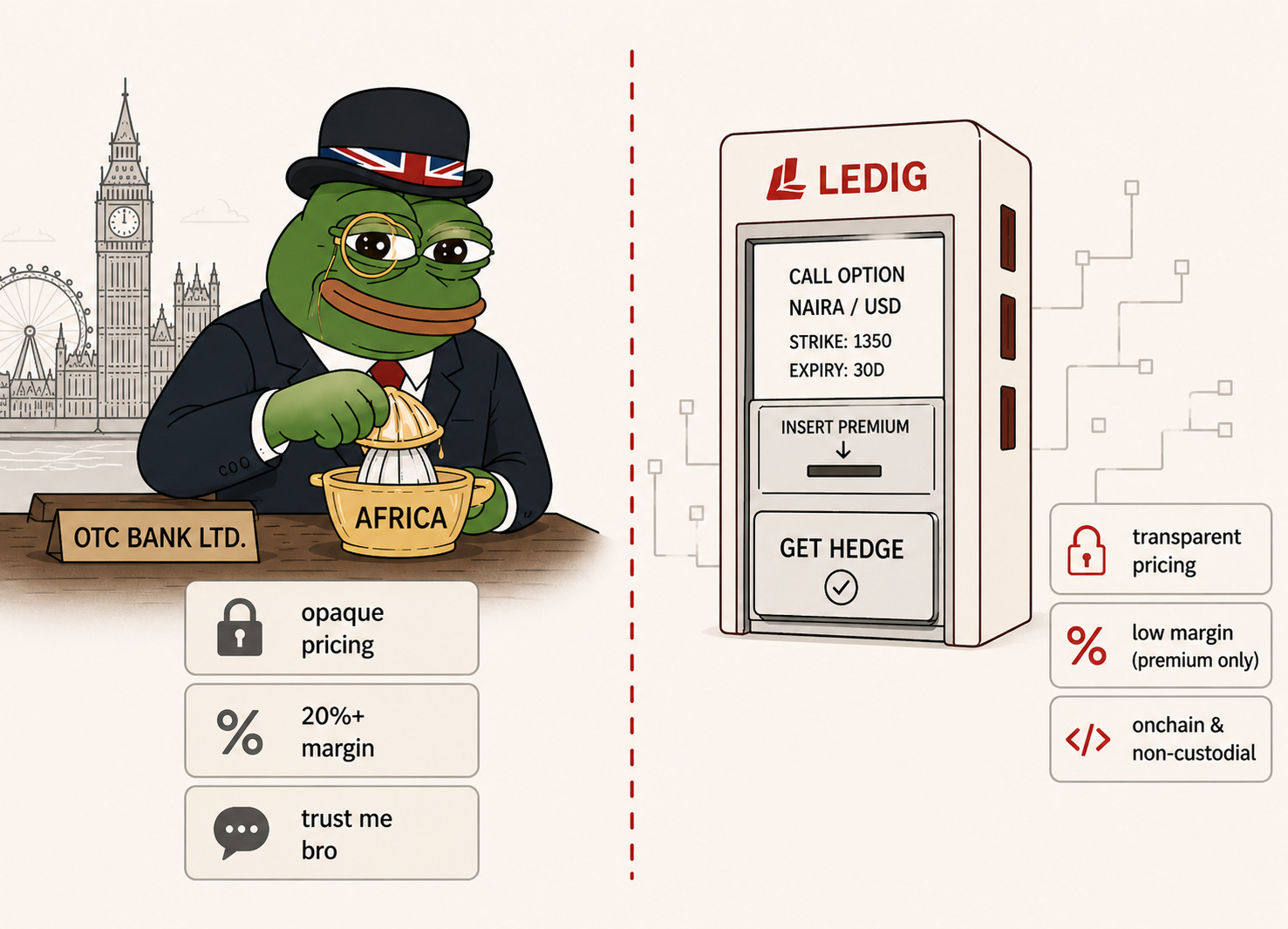
Options in Africa are predominantly used to hedge FX risk, which is vital to running successful businesses here, but the market runs through off-shore banks, mostly in London. These banks require steep margins and do not fully disclose how they price the options they sell.
Ledig, a team that lives this problem, has built a market for on-chain call options where all participants can price risk in the open. They have already facilitated derivative contracts worth $48M. The real demand is much higher.
We’re interested in this because:
Onchain derivatives may be more constructive than their offchain ancestors, once labelled as “weapons of mass destruction”. This is because the orderbook is open and verifiable (so the price gouging that worried Buffett no longer happens) and DVP is instantaneous and programmatic.
These features can be leveraged in non-extractive, manipulation-resistant ways. Ledig’s onchain call options demonstrate how this applies to emerging markets, and they’re following what we think is the right sequence for making them usable and attractive.
Onchain derivatives rely on programmable underlying assets and present a new frontier in the use of local stablecoins, which we have been tracking.
Sequence Matters
The perpetual swap Hayes implemented at BitMEX in 2016 is superior for two reasons: it concentrates liquidity in one contract, and it enables people to take more leverage than any other instrument. It is simple and, if you side with Hayes, safer than any traditional alternative.
It is true that options fragment liquidity in ways perps don’t. This is a powerful fact in favour of perps, as it means better price discovery. It may even be the case that perps become the building blocks of most other derivatives, as we’re seeing with HIP-4. But there is still a strong case for why we need other derivatives like options.
Options have a fundamentally different payoff curve, and enable positions perps cannot. Specific kinds of options play a critical role in emerging markets, which are less about maximizing leverage, and more about making sure that those who want to sell risk can find willing buyers, and vice versa.
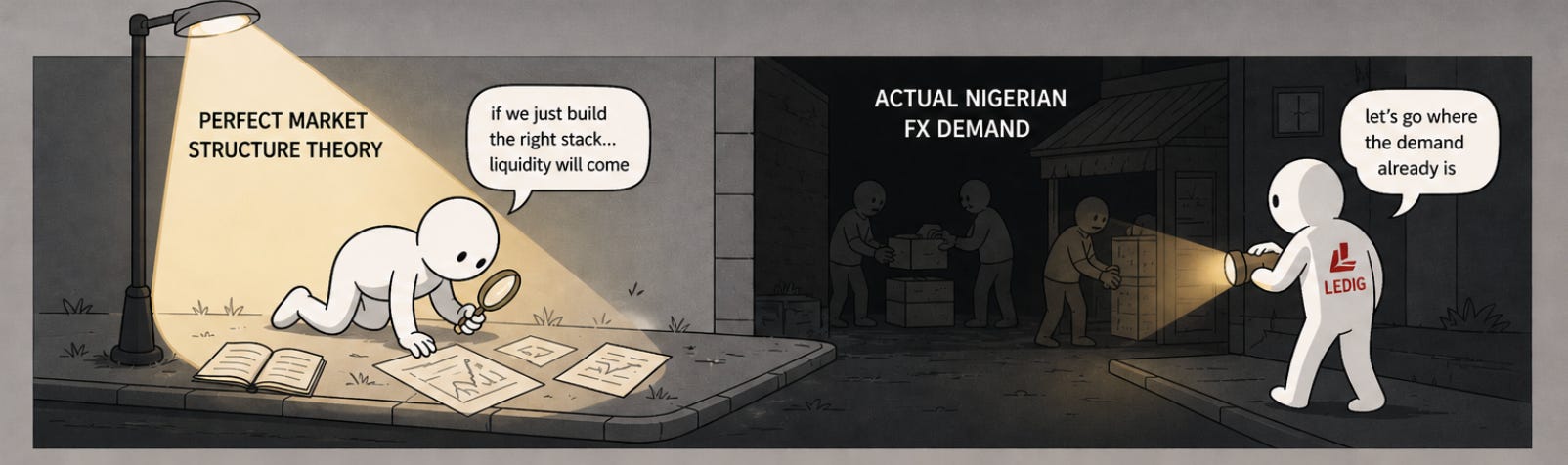
What is true regardless of the derivative is that going directly to where there is already a latent market, and hence deeper liquidity, has been the winning strategy. Hyperliquid went after perps first, and only later opened spot markets. Ledig is not starting with a more coherent spot market, or trying to create a more liquid futures market: they’re selling call options today to people who need to sell some of the risk associated with holding Naira.
Once they have the critical mass of liquidity Hayes discusses in “Adapt or Die”, then they can branch out into building a better futures exchange and the more theoretically “correct” structure, but not before then.
What’s The Price?
Ledig’s approach is informed by the crucible of operating derivatives products in Africa without a blockchain. Instead of blindly following theory, they create fixed-price series of call options against the Naira onchain, and let writers dictate their own premium.
Any writer can sell call options at, say, 1350 Naira to USD, with some premium they decide that expresses their actual view of the fair price. The implications are interesting:
No oracles: price discovery happens onchain by virtue of which premium clears the market. This simplifies the contracts. No oracles or mark-to-market logic (with MEV consequences) reduces the attack surface, which is something everyone should care about in the wake of rsETH, Drift, and advancing AI capabilities.
Buyers only need to pay the premium, as opposed to ~5-20% of the notional value. This really matters in emerging markets, and it is why Ledig will win customers 100x faster than other options writers trying to play in the same arena.
Writers warehouse more risk, but they already specialise in this. Everyone we spoke to is happy to use Ledig because they are still making more profit (even with an appreciating Naira and strange macro conditions) than they can from buying government bonds (which yield ~16% annually).
The traditional theory goes something more like this: we need a reliable spot market to anchor prices, and then we need a functioning futures market in order to produce a reliable forwards curve, which we can then use to price options correctly and compress the premiums. We really appreciate the theory, though building all these layers and making them work together in markets like Nigeria is incredibly tough.
In general, we expect simple onchain contracts with transparent pricing mechanics to scale well across many emerging markets, not just because they are inherently more secure, but because they answer the needs of many businesses in such markets, and so win more liquidity.
Hyperliquid is infrastructure that enables traders to take much more leverage than traditional instruments can safely offer, because the liquidity is concentrated and accessible. Ledig is infrastructure that enables businesses to sell or buy risk in more precise ways at prices that are discovered in public, with minimal liquidity requirements.
Both are required if “all of finance” is going to come onchain.
The People
It is gratifying to encounter industry experts–people who have been doing what they do for decades or more–who are bringing their work onchain in ways that defy conventional wisdom.
Chiagozie Iwu, Ledig’s founder, is exactly one such person. He is quiet, smart, and has a clear vision for how derivatives will improve emerging markets. He is genuinely passionate about realising that vision. Genuine passion is the rarest coin there is.
His cofounder, Sylvester Kalu is a street-smart operator. He’s the “fixer” who will fly from Lagos to wherever you are, open his computer next to you and settle the trade however makes you feel most comfortable before showing you what modern tools can really do. He is responsible for liquidity and customer relationships. They are the same thing in this game.
Chiagozie and Sylvester are using the best of what is available globally, and adapting it to the specific requirements of African markets in ways which make sense to the people who live here. In so doing, they’re forging a path that any emerging market founder can follow. While perps will likely always dominate volumes and short-term price discovery, we think there is a vast design space of constructive ways we can use advanced financial instruments that will not just unlock, but actively create, significantly more value for everyone across the world.
We are excited to build alongside Ledig as they craft custom tools that give people more expressive financial agency at prices they can afford.
If you are building derivatives to solve fundamental problems in emerging markets, we would like to speak with you.