
Is the Stablecoin Neobank in the Room With Us?
What stablecoin neobanks actually control, and where durable value accrues in Africa’s financial stack.


For the fourth time that quarter, I opened two decks side by side and went looking for a difference. Different colours. Different names. Same company: dollar accounts, crypto cards and automated FX. By the third deck, every claimed moat had already shown up as someone else’s feature.
Earlier this year, Grey, the YC-vetted incumbent that spent years anchoring the African freelancer economy, bolted USDC onto its existing stack with no rebrand or raise. Raenest followed, then a procession of others.
What gets pitched as a revolutionary category is a commoditizing distribution layer: once the utility is proven, generic frontends are exposed to incumbents who already own the user, and durable economics accrue to whoever controls a scarce function in the stack. A founder in Nairobi asked the LAVA team last month whether stablecoin neobanks were investable. This is the long answer.
What Is a Bank, Actually?
“Neobank” is doing a lot of work in these decks. The word borrows the weight of banking (deposits, regulation, a balance sheet) for products that usually have none of it. When Nubank or Revolut use the label, it has some basis: Nubank extends credit at scale and Revolut holds a European banking license.
A bank is defined by its function in the monetary system: making markets, transforming maturities, creating credit, warehousing risk, all while trying to stay liquid. Banks are dealers in balance-sheet capacity and their profit comes from spreads, financing margins, and the risk borne.
Apply that standard to companies calling themselves stablecoin neobanks and they sort into three functions:
A distribution layer routes value through rented rails: someone else’s stablecoin (Circle, Tether), someone else’s cards (Bridge, Rain), someone else’s off-ramps. It bears no financial risk, deploys no capital, and earns interchange of 1–1.5%, split with the issuer.
A dealer uses its own capital to provide liquidity at the boundary between stablecoins and local currency. It quotes prices, absorbs order flow, warehouses inventory risk, and earns the bid-ask spread.
A balance-sheet intermediary borrows, lends and manages the maturity mismatch between the two to earn the net interest margin. As is shared by the Kernel Community, what “drives the action (and hence the power) in the banking system is the liabilities side of the balance sheet, not the assets,” where institutions access funding and participate in clearing networks.
Most companies in the category are the first, pitching as the third, and raising at valuations appropriate for the third.
Note: These are not mutually exclusive categories. Since these are functions, one company can distribute USDC, quote FX with its own capital and originate credit through a partner. The taxonomy is useful because it shows which part of the company produces the margin.
The $10,000 Bank
Every deck looks the same because the features are cheap to assemble.
Bridge and Rain, the two firms issuing crypto-linked cards for most of the ecosystem, control roughly 60 percent of global crypto card volume. Launching a card program through one of them costs approximately $10,000 to $15,000 upfront and $2,000 to $3,000 a month.
Meanwhile, look at who’s actually getting paid. Bridge, acquired by Stripe for $1.1 billion, processed over $5 billion in card payments in 2025. Rain, valued at $2 billion, processed over $3 billion. Both earn API fees, interchange splits, and yield on float: tens of billions sit inside their systems at any moment against daily outflows in the hundreds of millions. One level up, Tether earned roughly $6.3 billion in profit in the first half of 2025 simply by holding reserves against its liabilities.
The stack has four layers, and value settles around its scarcest functions. The issuer (Circle, Tether) earns yield on the entire reserve base. The infrastructure (Bridge, Rain) captures the float. The dealer earns structural spread. The distribution layer (most stablecoin neobanks) fights over interchange fees.
The unit economics are brutal. A user depositing $200 a month generates roughly $1.50–$2.25 in monthly interchange revenue, against customer acquisition costs of $15–$50. Compare that with Onuorah, the man I sell USDC to. I message him on WhatsApp, often at an ungodly hour. He sends a rate and settles within minutes without a consumer app or marketing budget. On a good day, he might move $10,000 at a gross spread of two or three percent (~$200–$300) before capital costs and the trades that go wrong. The informal dealer is a structurally superior economic actor to the venture-funded frontend.
We watched one founder discover this the expensive way. His wallet-and-card product grew volume eightfold, but revenue later fell 32.7 percent in a single quarter. “Stablecoin neobanking and crypto cards are increasingly commoditized,” he acknowledged. He began looking for a regulated stablecoin FX clearinghouse to acquire, in order to move further down the stack.
Promises, Not Dollars
This structure isn’t an accident of the current market. It falls out of how money itself works: money is hierarchical.
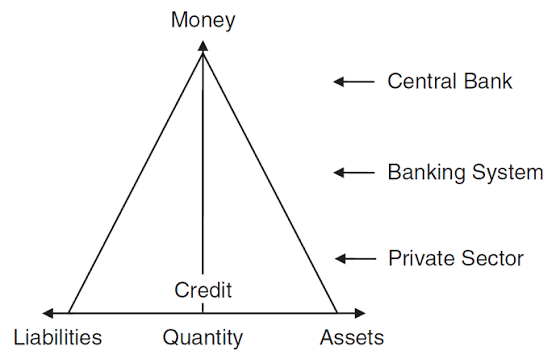
Perry Mehrling’s Money View, developed at Boston University and the Institute for New Economic Thinking, puts central bank reserves at the top of the hierarchy, bank deposits (promises to pay reserves) below, and credit (promises to pay deposits) below that. A BIS working paper co-authored by Mehrling locates stablecoins precisely: they are to on-chain finance what Eurodollars are to offshore finance: promises to pay dollars. The difficulty is par: maintaining the one-for-one promise across the on-chain/off-chain boundary.
The Eurodollar system defends par with interbank credit markets, forward contracts, and Federal Reserve swap lines. The on-chain system has none of this: no interbank market, no lender of last resort. When Circle disclosed $3.3 billion at Silicon Valley Bank in March 2023, USDC depegged to $0.87 and the shock cascaded through everything built on it. With no deliberate backstop, the Fed’s rescue of SVB was also a rescue of USDC.
A Cambridge study found that by late 2025, each dollar of base assets in DeFi supported $4.70 of layered claims. In every crisis (Terra, FTX, SVB), the hierarchy reasserted itself as participants scrambled toward higher-quality money.
Value accumulates where someone defends par, provides liquidity or commits a balance sheet. Most stablecoin frontends do none of the three.
Africa’s Fractured Hierarchy
The hierarchy is easiest to see in Africa, and especially in Nigeria, because formal dollar access already fails.
Not long ago, more than 90 percent of Nigeria’s USD liquidity flowed outside the banking system. Banks suspended card-based USD transactions for three years. Even after easing, limits sat near $500. In 2024, $59 billion in crypto transacted in Nigeria (roughly 31 percent of nominal GDP) and stablecoins account for 43 percent of all on-chain transaction volume in Sub-Saharan Africa. The USDT price on Binance P2P became the de facto reference rate, and Schelling Point for the parallel naira market.
Stablecoins have inserted themselves into the middle of this fractured hierarchy. For a Lagos freelancer or an Onitsha importer, USDT is a practical substitute for bank-mediated dollars. It is often a better one, because the bank cannot provide them.
But, practical superiority is not hierarchical superiority. The hierarchy gets obscured in normal times and reasserts itself in crunches. Reserve-backed stablecoins remain promises to pay dollars everywhere, including Lagos. And in African markets, the par that actually matters is whether you can convert USDT to naira at a predictable rate when you want to buy Item7 shawarma or MelonyPine’s overpriced parfait. That local par is defended by Onuorah and a thousand like him, with no institutional backstop whatsoever. When the naira-USDT spread blows out during FX stress, no app design can save the value proposition.
This is also why the real competitor to a stablecoin neobank is the informal economy that already serves the users at lower cost, with zero CAC, deeper local trust, and no obligation to produce venture-scale growth.
The Bull Case, and Where It Breaks
The strongest counterargument: every major neobank started as a distribution layer. Nubank began as a no-fee credit card on a partner bank and is now worth $80 billion. Distribution, the argument goes, is a phase: acquire millions of users, then upsell into credit.
But, three things break this argument:
Survivorship bias. For every Nubank, dozens of neobanks acquired millions of users and never achieved structural margin. The ones that transitioned did so by building credit products: SoFi through refinancing, Nubank through cards, Chime through secured lending. The pivot was a strategic migration toward captured economics and the risk-bearing functions of balance-sheet intermediation.
Open rails don’t lock in. M-Pesa and WeChat Pay built closed loops so value stayed inside. A stablecoin wallet operates on open rails: USDC sent from one wallet arrives identically in any other. The very permissionlessness that makes stablecoins powerful prevents any frontend from owning the network.
Credit is the hard part. The Nubank path requires underwriting, loss reserves, regulatory capital, and the willingness to warehouse risk. In Africa it also requires solving the FX mismatch: lend USDC to a naira-earning business and a 30 percent devaluation (which we watched happening in real time in 2023–24) converts FX risk into credit risk overnight. The hedging instruments barely exist on-chain. Companies raising bank valuations on distribution economics are pricing in a transition their cap tables may not survive.
Distribution can still be a moat for founders building in the space. But it requires something the next wallet cannot rent: a proprietary workflow, regulatory access, underwriting data or an unusually strong customer relationship. As such, our argument is narrower: access to a user interface and fungible stablecoin rails, without one of these reinforcing advantages, is unlikely to constitute a moat. If nothing compounds, dependence on infrastructure providers increases with growth, rather than bargaining power.
Scarcity’s Zip Code
Balance-sheet intermediation produces durable economics only where the intermediary combines cheap funding and disciplined underwriting.
The founder who goes hunting for a license isn’t unusual. They have hit the category’s floor: once distribution commoditizes, you either find a scarce function or stay dependent on whoever owns one.
The investable positions are wherever a critical input remains scarce: liquidity, balance-sheet capacity, or regulatory access.
The corridor dealer. One dealer in our pipeline processed $1.6 billion in 2025 at a take rate of only 0.11 percent. The following year, it walked away from 40 percent of its volume and began pricing FX and settling transactions itself. Revenue reached a $9 million run rate, with 50 percent EBITDA margins. Then it hit another wall with daily demand rising to $10 million, but its balance sheet holding only $8 million, and external liquidity costing 36 percent a year. The company had found the margin and then discovered it could not afford enough of the capital required to capture it.
Open financial infrastructure. The investable case for tokenization begins when putting an asset on a public ledger creates a liquid market where none existed. In Africa, that means infrastructure through which global capital can price and hedge locally scarce risks: reliable FX oracles, permissionless derivatives, atomic settlement and programmable instruments. Durable value accrues to the market architecture that attracts diverse liquidity, improves price discovery and gives African businesses tools to manage risks that existing financial institutions price poorly or do not serve.
The credit originator. This is where structural margin finally settles. We are tracking a lender facilitating $120 million in annual originations. Its next source of capital may be on-chain: publishing verifiable performance data could allow global investors to fund its loan book. But dollar-funded lending to local-currency borrowers cannot scale safely without a way to hedge the FX mismatch. This is part of the thinking behind Ledig, and our position on Onchain FX.
For dealers and balance-sheet intermediaries, funding is often the binding constraint. A licence authorises activity and may provide access to deposits or clearing, but durable economics depend on repeatedly sourcing capital at the right cost, tenor and currency, then keeping credit, FX and liquidity losses below the spread earned.
Three Questions
The stablecoin-neobank wave is transitional, but necessary. It is teaching people to hold, move and spend dollars on-chain. More importantly, it is drawing a map of where banks stop: local liquidity, FX risk, credit and trust.
We could be wrong. In fact, my fallibility is a constant that is starting to be a concern to my friends and family. Three things would change our view: users becoming genuinely loyal to stablecoin frontends, incumbents proving unable to copy their features, or interchange remaining more resilient than the evidence currently suggests. None looks particularly likely today.
Founders should be able to name what they will still control when the frontend becomes interchangeable, how that function produces margin and why the next company cannot simply rent it. Investors should underwrite the economics behind the volume slide. Regulators should supervise the risk being carried, whatever the landing page calls the company.
Every quote commits Onuorah’s capital, so he does have a balance sheet, even if it is small and informal. He and dealers like him defend local convertibility, turning the dollar promise into naira when formal institutions will not. His moat is repeated settlement, and the memory of having been there every time Access Bank did not have dollars. That, too, is a scarce function, and perhaps the hardest one for venture capital to underwrite.
So, is the stablecoin neobank in the room with us?
Look for yourself. When a founder says “stablecoin neobank,” ask three questions:
Where is the balance sheet?
Who defends par?
What happens in stress?
If the answers are “nowhere,” “someone else,” and “we hope for the best,” you are looking at a frontend . You must price it accordingly.
NB: LAVA is a crypto-native, early-stage venture firm investing across Africa. This essay draws on our deal flow, portfolio data, and research including the BIS Working Paper “On Par: A Money View of Stablecoins” (Aldasoro, Mehrling, Neilson).