


Over 60 people applied for our Master of Narratives role, where instead of CVs and cover letters, we asked them to do the real work. Pick any Web3 startup operating in Africa and answer a question:
“Why does it matter?”
We received submissions, mostly written but some videos, from across the continent and beyond. Over four months, we went back and forth with candidates—emails, calls, and rewrites.
Today, we’re sharing the final of three winners: Tosin, who's been demystifying the latest and strangest crypto incantations for years, writes "Interoperable money as the next layer of value."
She picks up onchain FX and local currency stablecoins to drive home the point that geographical proximity doesn’t guarantee financial interoperability. And that there are already some building blocks in place that attempt to solve financial fragmentation across Africa, at scale. We loved the depth and specificity of this piece that showed how onchain innovations solve everyday problems big and small.
Interoperable money as the next layer of value
How Mento Labs is rethinking cross-border money with oracle-priced FX, and code that respects local utility.
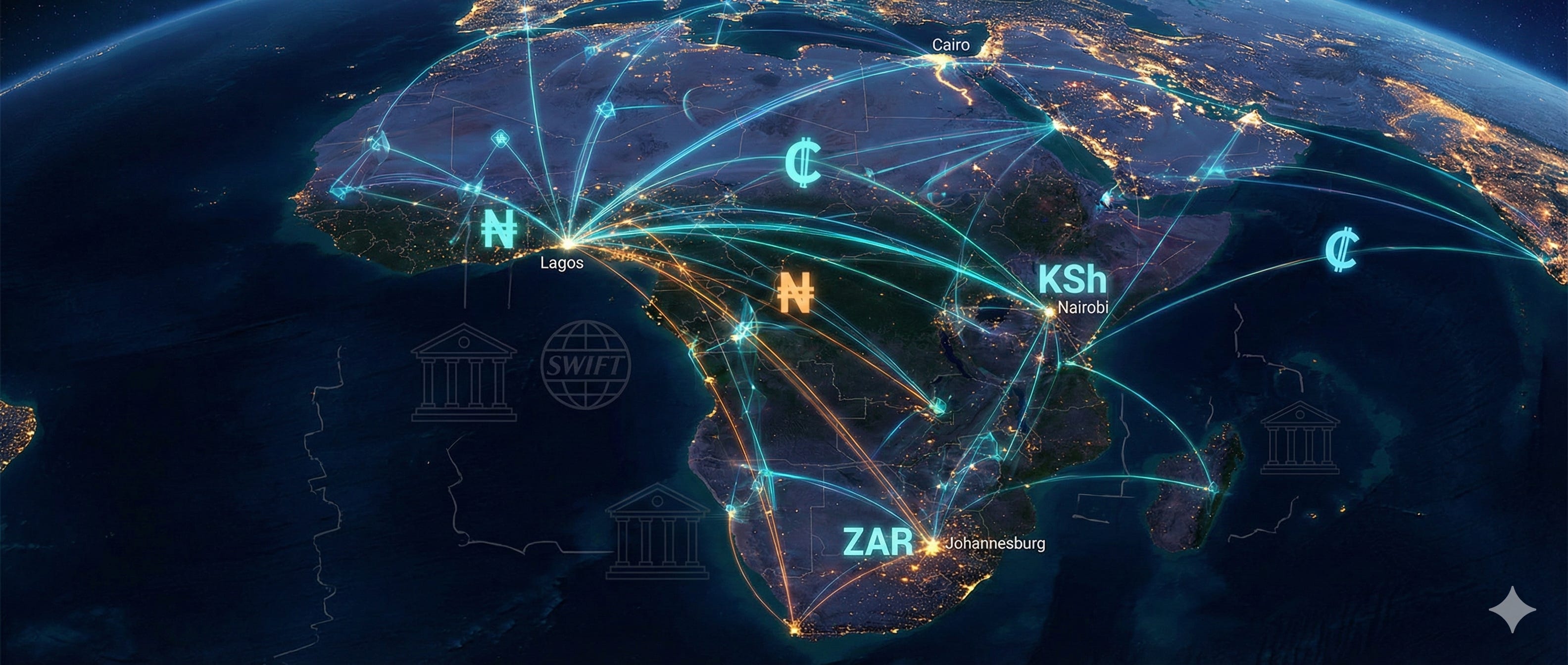
Between Nigeria and Ghana, the distance is barely an hour’s flight—shorter than the average home-to-work commute within Lagos on a regular day. The two countries share everything from trade routes and pop culture to family ties. You’ll find Nigerian students in Accra ordering food from home multiple times a week, and Ghanaian workers in Lagos paying fees back home in cedis.
Yet for all this closeness, moving money between them feels like crossing an ocean. The same bank names—Zenith, UBA, Ecobank—exist on both sides, and both nations have hacked instant local transfers. But interoperability remains non-existent. The real economy—the one that actually moves—runs on WhatsApp agents at odd hours, black-market rates, and hand-carried cash across the border. This isn’t a unique story; it’s the norm for sister countries across the continent: Zimbabwe and South Africa, Kenya and Tanzania.
Even for those who turn to stablecoins like USDT, the problem doesn’t end. You still convert into a foreign currency, taking on FX risk the moment you leave your home denomination. A Ghanaian worker paid in Naira but transacting in USDT is exposed to the same volatility that destabilizes small businesses and local credit markets.
This is financial fragmentation up close. And it’s the gap projects like Mento Labs are trying to bridge by rebuilding what cross-border money should be.
Their work builds on stablecoin infrastructure, but its power is in preserving one-to-one parity with local fiat. Mento’s framework lets digital versions of currencies like NGN, KES, and GHS move across ecosystems, settle instantly, and neutralize the settlement/FX basis risk that defines cross-border transactions.
The answer is an FX layer native to the internet—one that respects local value while ensuring its mobility. Mento’s platform already reaches millions through Celo wallets like Valora and Opera’s MiniPay, a fact underscored by its over 400,000 monthly active users—an unmistakable proof of core demand.
The goal is interoperable money, not homogeneous money. It’s about making money useful everywhere while preserving local meaning.This is the crucial distinction between financial innovation and financial erasure.
The Mechanics: Interoperability via the Fixed Price Market Maker (FPMM)
Mento’s core innovation is its Fixed-Price Market Maker (FPMM), an oracle-anchored mechanism that executes swaps at real-world FX rates. Unlike curve-priced AMMs, this model avoids complex mechanisms and value-draining risks like Loss-Versus-Rebalancing (LVR). It’s backed by a diversified, transparently managed reserve and differs from curve-priced AMMs in three main ways:
Oracle-driven pricing: The FPMM doesn’t discover price via liquidity curves like a standard AMM, it imports it. Decentralized oracles feed live, institutional-grade FX rates directly to the protocol. This provides a verified, real-world reference price for each currency pair (say, cNGN/cGHS), rather than routing through a USD pair.
Deterministic liquidity: Instead of user-supplied pools, trades draw from the Mento Reserve—a diversified basket (e.g., BTC, ETH, CELO) that absorbs volatility, restores balance when demand skews, and acts as counterparty of last resort. The result is low-slippage execution that’s capital-efficient, transparent, and composable with other on-chain apps. When demand skews, the system can rebalance inventory (e.g., mint/burn against the reserve) to keep pairs liquid without drifting from the oracle price
Atomic Cross-Currency Swaps: Powered by those oracle-anchored rates and reserve liquidity, a Ghanaian worker in Lagos can swap their earnings from a digital Naira to a digital Cedi for a relative in Accra at the current interbank rate. The transfer settles in seconds, costs a fraction of what it would with the traditional flow, and never touches a single SWIFT code or correspondent bank—digitising a complex, multi-day swap into a single, instant command.
Most digital money today still travels through the dollar. Mento rewires that logic, letting value move directly between local currencies, without detour or dependency.
When global money breaks local credit
The true test of a foundational financial primitive is not whether it can move money, but whether it strengthens the local economy beneath it.
The global stablecoin regime dominated by USD is a poor fit for emerging markets. This creates a critical currency mismatch risk. If an African micro-entrepreneur whose revenues are in local currency takes a loan in cUSD, any local currency depreciation instantly increases their debt burden when measured against their local income. This FX risk is a ceiling on local credit. It destroys trust and makes productive lending—on-chain or off-chain—hard to scale for the people who need it most.
Mento’s model flips this dynamic. By creating stable, digital representations of local currencies, it provides a reliable digital denominator for local value that eliminates FX risk for the end user.
Proof points in local credit: From Kenya to Ghana
This isn’t just theoretical. The model is already being proven on the ground:
In Kenya, the adoption of cKES provides a critical proof point. A micro-credit pilot program with Haraka disbursed over 1.5 million cKES to 150 micro-entrepreneurs, 85% of whom are women. These individuals were not borrowing a foreign currency; they were borrowing the digitally stable version of the currency in which they earn their income.
In Ghana, a similar pilot with Mercy Corps Ventures, Haraka, and the Grameen Foundation used Mento’s digital Cedi (cGHS) to disburse loans to over 500 women in village savings groups. The impact was immediate: loan disbursement times dropped by 99.7%, from an average of one week to under five minutes.
In both cases, this model:
Reduces reliance on predatory local money lenders who charge exorbitant rates.
Decouples local credit from the volatility of global reserve currencies.
Empowers local growth by ensuring entrepreneurs can plan and repay their loans without the spectre of sudden, crippling FX swings.
The demand for this local utility is clear. A separate partner project with Fonbnk demonstrated that users making initial cKES transactions were 25% more likely to continue with additional transactions, highlighting strong engagement and preference for a local digital currency.
The human cost of friction
I once spoke with a Nigerian student at a university in Accra who described how trying to pay her tuition when she first arrived became a week-long nightmare of apps that didn’t work, failed bank visits, and dead ends with traditional remittance – finally resolved only through an informal P2P agent on WhatsApp.
This agent, a Nigerian living in Ghana for decades, doesn’t compete with the formal system; he exists because it’s broken. He uses his own float in both countries to clear transactions and sets his own rates because he has no efficient competition. He is the human API of a fractured network.
The sheer absurdity of this friction highlights the human cost. It’s blocked potential, stressed families, and missed opportunities.
Mento’s rails are built to replace the human API. They digitize the value that, until now, has been trapped in WhatsApp chats, finally letting it flow as freely as the people who earn it.

really enjoyed this piece, thank you! have been thinking about similar issues and this deep dive was very helpful. the whole series has been great, LAVA.