


Over 60 people applied for our Master of Narratives role, where instead of CVs and cover letters, we asked them to do the real work. Pick any Web3 startup operating in Africa and answer a question:
“Why does it matter?”
We received submissions, mostly written but some videos, from across the continent and beyond. Over four months, we went back and forth with candidates—emails, calls, and rewrites.
Today, we’re sharing the first of three winners: Jolade, who shifted gears from her usual technical writing to write "The Untapped Liquidity of Human Capital: How Web3Bridge Turns Potential into Global Impact."
Her writing is the most comprehensive piece written about Web3Bridge (we've read thus far) and a pure labor of love. She goes inside the Ikorodu compounds—how they run, who shows up, what actually happens there, and builds the story from the ground up. She digs deep to pull from alumni stories, X Spaces, and goes as far as reaching out to Web3Bridge alumni directly to better understand their lived experience.
The Untapped Liquidity of Human Capital: How Web3Bridge Turns Potential into Global Impact
The rarest resource in the global Web3 economy is not capital - it’s talent.
Developers who truly understand smart contract security, token economics, and protocol design are in desperate demand.
Since 2019, Web3Bridge has been transforming raw, overlooked potential into world-class developers that the global ecosystem desperately needs.
Over 880 students on blockchain development, with 300+ graduates now working for companies like Polygon, Nestcoin, Nahmii, Aavegotchi, Nethermind, and Consensys. While others have launched startups.
The training model is straightforward: remove infrastructure barriers, provide hands-on protocol experience, and connect graduates to the global opportunities.
When Starknet distributed 728 million STRK tokens to 1.3 million wallets worldwide in 2024, Web3Bridge alumni collectively received tokens worth over $2 million worth of tokens. Not as airdrop farmers, but as developers who contributed code to the protocol.
Events like this reflect a bigger reality.
By 2030, Africa will have the largest youth workforce on the planet. Millions of young people are digital-first, mobile-native, and hungry to build. What they lack isn’t ambition, it’s access.
Web3Bridge was designed to remove that friction through its immersive 16-weeks bootcamp with five-hour sessions daily, where participants across the continent live together, code together, and learn blockchain hands-on. Everything – accommodation, 24/7 electricity, food, and internet is provided free of charge.
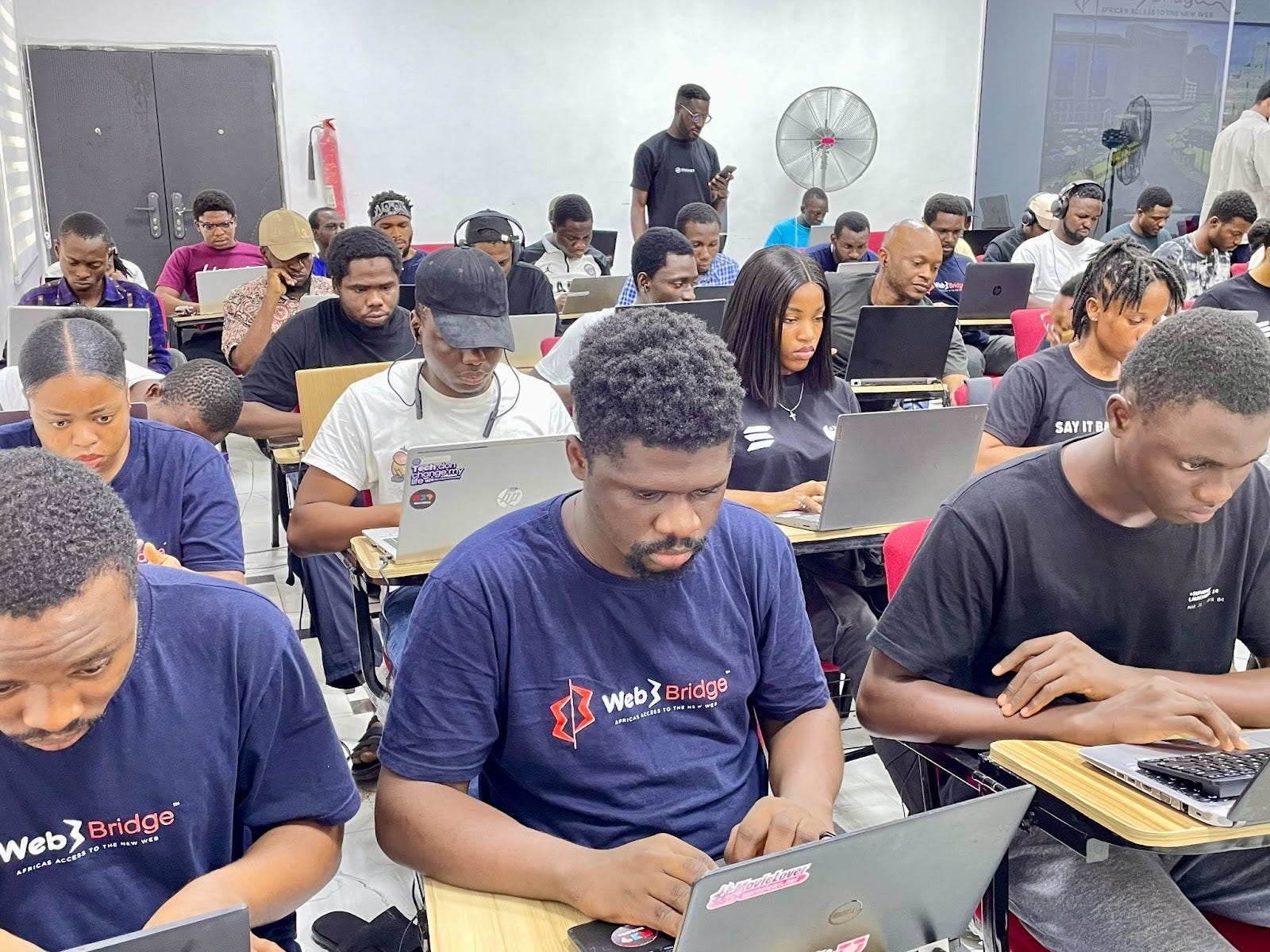
In a region where blackouts can kill ambition overnight, this consistency is transformative – not charity, but infrastructure for the untapped capital. This is liquidity provisioning at its purest.
Building the Bridge
The curriculum focuses on production-level skills. Students learn blockchain basics, Ethereum architecture, Solidity for smart contracts, libraries like EtherJS and Web3JS for interacting with contracts, development tools like Hardhat and Foundry, and NFT implementation.
But the real work happens through protocol contributions. Students fork repositories, audit smart contracts, and contribute to live codebases for protocols like Ethereum, Lisk, and Arbitrum.
Ayodeji Awosika, Web3Bridge’s founder, started the program after seeing Ethereum’s “One Million Devs” initiative. His background wasn’t computer science, he studied hospitality and business management, then entered blockchain in 2017 as an airdrop hunter and community moderator. What he discovered was a gap: African developers wanted to build in Web3, but most lacked the Web2 programming foundation to transition.
Web3Bridge began with Web3 training but soon realized many entrants lacked Web2 development skills. The program evolved to include a 12-week remote track teaching HTML, CSS, and JavaScript for complete beginners before the main blockchain cohort. After all, you can’t write smart contracts without first understanding how code works.
Take Aisha, a 22-year-old computer science graduate who once streamed coding tutorials on a dying phone battery. Her degree wasn’t enough to break into the job market, and constant power cuts made learning impossible.
When she joined Web3Bridge, everything changed, surrounded by peers as curious as she was. Within weeks, she began writing her first DeFi smart contract, collaborating with peers to audit code, and contributing to an Arbitrum-based project.
Upon graduation, Aisha had landed a remote role with a Web3 startup, her income now supporting her family, her code securing live protocols and her story fuels dozens of other women to follow.
Beyond training, Web3Bridge also organizes the annual Web3Lagos Conference, a gathering of developers, founders, and innovators across the continent. Through keynotes, workshops, and hands-on discussions, it extends the same ethos of access and belonging into the real world. For many alumni, the conference isn’t just about innovation, it’s a community in motion where mentorship deepens, collaborations begin, and a sense of shared mission takes root.
It’s where Africa’s blockchain story becomes visible, loud, and confident.
The Scarcity This Actually Solves
Now, Web3Bridge is expanding beyond Solidity. Its new curriculum introduces ZK (zero-knowledge proofs) and Rust – the languages powering the next generation of scaling solutions.
It’s also partnering with the University of Nigeria to train computer science and ICT students during their six-month industrial training period. Students learn smart contract development, ensuring graduates return to school job-ready.
Founder Awosika Ayodeji believes fixing education, infrastructure, and mobility could solve 70% of Nigeria’s problems and Web3Bridge is proving that through code.
Proof of Impact, Not Promise
Web3Bridge measures success not in certificates, but in deployed contracts, startups, and economic mobility.
Alumni-led ventures like CoinSafe, HostIT, Stormbot and Guild Audit prove the model works.
Each startup tells the same story: when opportunity meets access, potential becomes impact. Together, these founders mentor new developers, build local ecosystems, and expand Africa’s presence in the global Web3 economy.
Industry partners have taken notice. Collaborations with Lisk and Starknet connect alumni to grants, hackathons, and job placements, creating a virtuous cycle: learn, build, earn, reinvest.
For Web3 to scale, liquidity in tokens isn’t enough. The ability for knowledge and skill to move fluidly across borders is just as critical. And when unlocked, human capital becomes the most valuable liquidity Web3 can have – renewable, scalable, and decentralized by design.
The next Ethereum-scale innovation might come from Nairobi
The breakthrough in decentralized identity could emerge from Lagos.
The next evolution in DeFi could be prototyped in Cape Town.
With initiatives like Web3Bridge, Africa is not just a passive participant, it becomes an active co-author of the decentralized web.
